MID TERM TEST MODEL PAPER (FUNCTIONS,VECTORS,SIMILARITY,POLYGONS, VOLUME
Extended • Paper4
Question Numbers
Question 1
4 mark(s)
\[
\mathbf{u}=
\begin{pmatrix}
3\\
-2
\end{pmatrix}
\qquad
\mathbf{v}=
\begin{pmatrix}
-12\\
5
\end{pmatrix}
\]
\mathbf{u}=
\begin{pmatrix}
3\\
-2
\end{pmatrix}
\qquad
\mathbf{v}=
\begin{pmatrix}
-12\\
5
\end{pmatrix}
\]
(a)
Find \(\mathbf{u}-2\mathbf{v}\).
[2]
\[
\mathbf{u}-2\mathbf{v}
=
\begin{pmatrix}
3\\
-2
\end{pmatrix}
-
2
\begin{pmatrix}
-12\\
5
\end{pmatrix}
\]
\[
=
\begin{pmatrix}
3\\
-2
\end{pmatrix}
-
\begin{pmatrix}
-24\\
10
\end{pmatrix}
\]
\[
=
\begin{pmatrix}
27\\
-12
\end{pmatrix}
\]
\mathbf{u}-2\mathbf{v}
=
\begin{pmatrix}
3\\
-2
\end{pmatrix}
-
2
\begin{pmatrix}
-12\\
5
\end{pmatrix}
\]
\[
=
\begin{pmatrix}
3\\
-2
\end{pmatrix}
-
\begin{pmatrix}
-24\\
10
\end{pmatrix}
\]
\[
=
\begin{pmatrix}
27\\
-12
\end{pmatrix}
\]
(b)
Find \(|\mathbf{v}|\).
[2]
\[
|\mathbf{v}|
=
\sqrt{(-12)^2+5^2}
\]
\[
=
\sqrt{144+25}
\]
\[
=
\sqrt{169}
\]
\[
=13
\]
|\mathbf{v}|
=
\sqrt{(-12)^2+5^2}
\]
\[
=
\sqrt{144+25}
\]
\[
=
\sqrt{169}
\]
\[
=13
\]
Question 2
\[
f(x)=3-2x \qquad g(x)=2x+3 \qquad h(x)=2^x
\]
f(x)=3-2x \qquad g(x)=2x+3 \qquad h(x)=2^x
\]
(a)
Find \(f(-3)\).
[1]
\[
f(x)=3-2x
\]
\[
f(-3)=3-2(-3)
\]
\[
=3+6
\]
\[
=9
\]
f(x)=3-2x
\]
\[
f(-3)=3-2(-3)
\]
\[
=3+6
\]
\[
=9
\]
(b)
Find \(gf(-3)\).
[1]
\[
f(-3)=9
\]
\[
gf(-3)=g(f(-3))
\]
\[
=g(9)
\]
\[
=2(9)+3
\]
\[
=21
\]
f(-3)=9
\]
\[
gf(-3)=g(f(-3))
\]
\[
=g(9)
\]
\[
=2(9)+3
\]
\[
=21
\]
(c)
Find \(f^{-1}(x)\).
[1]
\[
y=3-2x
\]
\[
2x=3-y
\]
\[
x=\frac{3-y}{2}
\]
\[
f^{-1}(x)=\frac{3-x}{2}
\]
y=3-2x
\]
\[
2x=3-y
\]
\[
x=\frac{3-y}{2}
\]
\[
f^{-1}(x)=\frac{3-x}{2}
\]
(d)
Find \(x\) when \(gg(x)=7\).
[3]
\[
gg(x)=g(g(x))
\]
\[
g(x)=2x+3
\]
\[
g(g(x))=2(2x+3)+3
\]
\[
=4x+9
\]
\[
4x+9=7
\]
\[
4x=-2
\]
\[
x=-\frac{1}{2}
\]
gg(x)=g(g(x))
\]
\[
g(x)=2x+3
\]
\[
g(g(x))=2(2x+3)+3
\]
\[
=4x+9
\]
\[
4x+9=7
\]
\[
4x=-2
\]
\[
x=-\frac{1}{2}
\]
(e)
Find \(x\) when \(h^{-1}(x)=5\).
[1]
\[
h(x)=2^x
\]
\[
h^{-1}(x)=5
\]
\[
x=h(5)
\]
\[
x=2^5
\]
\[
x=32
\]
h(x)=2^x
\]
\[
h^{-1}(x)=5
\]
\[
x=h(5)
\]
\[
x=2^5
\]
\[
x=32
\]
Question 3
3 mark(s)
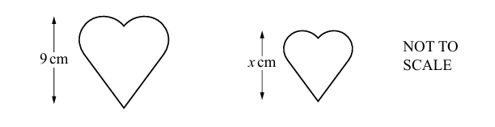
The two shapes are mathematically similar.
The area of the larger shape is \(36\text{ cm}^2\) and the area of the smaller shape is \(25\text{ cm}^2\).
The height of the larger shape is \(9\text{ cm}\) and the height of the smaller shape is \(x\text{ cm}\).
Find the value of \(x\).
The area of the larger shape is \(36\text{ cm}^2\) and the area of the smaller shape is \(25\text{ cm}^2\).
The height of the larger shape is \(9\text{ cm}\) and the height of the smaller shape is \(x\text{ cm}\).
Find the value of \(x\).
\[
\frac{x}{9}=\sqrt{\frac{25}{36}}
\]
\[
\frac{x}{9}=\frac{5}{6}
\]
\[
x=9\times\frac{5}{6}
\]
\[
x=\frac{45}{6}
\]
\[
x=7.5
\]
\[
x=7.5\text{ cm}
\]
\frac{x}{9}=\sqrt{\frac{25}{36}}
\]
\[
\frac{x}{9}=\frac{5}{6}
\]
\[
x=9\times\frac{5}{6}
\]
\[
x=\frac{45}{6}
\]
\[
x=7.5
\]
\[
x=7.5\text{ cm}
\]
Question 4
4 mark(s)
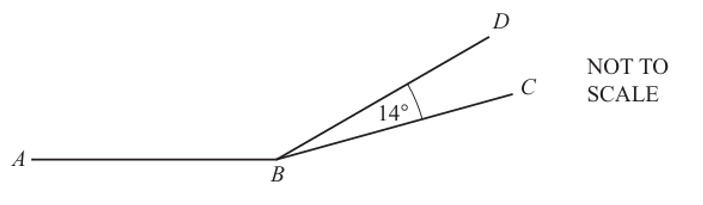
\(AB\) and \(BD\) are two sides of a regular \(15\)-sided polygon.
\(AB\) and \(BC\) are two sides of a regular \(n\)-sided polygon.
Angle \(DBC = 14^\circ\).
Work out the value of \(n\).
\(AB\) and \(BC\) are two sides of a regular \(n\)-sided polygon.
Angle \(DBC = 14^\circ\).
Work out the value of \(n\).
\[
\text{Exterior angle of a regular }15\text{-sided polygon}
=
\frac{360^\circ}{15}
\]
\[
=24^\circ
\]
\[
\text{Exterior angle of regular }n\text{-sided polygon}
=
24^\circ-14^\circ
\]
\[
=10^\circ
\]
\[
\frac{360^\circ}{n}=10^\circ
\]
\[
n=\frac{360}{10}
\]
\[
n=36
\]
\text{Exterior angle of a regular }15\text{-sided polygon}
=
\frac{360^\circ}{15}
\]
\[
=24^\circ
\]
\[
\text{Exterior angle of regular }n\text{-sided polygon}
=
24^\circ-14^\circ
\]
\[
=10^\circ
\]
\[
\frac{360^\circ}{n}=10^\circ
\]
\[
n=\frac{360}{10}
\]
\[
n=36
\]
Question 5
In this question all measurements are in centimetres.
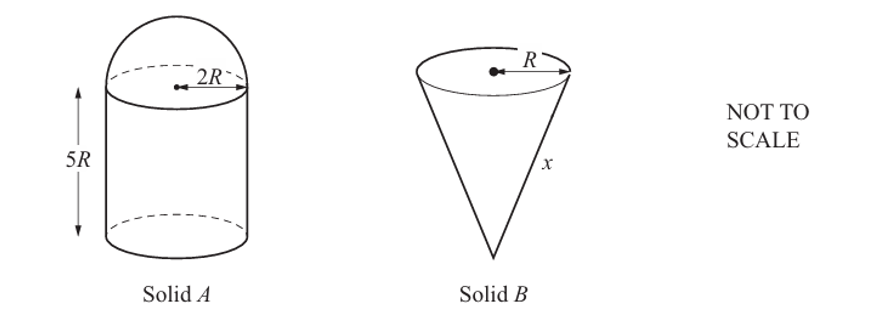
Solid \(A\) is made from a cylinder and a hemisphere, both of radius \(2R\).
The cylinder has height \(5R\).
Solid \(B\) is a cone of radius \(R\) and sloping edge \(x\).
The total surface area of solid \(A\) is equal to the total surface area of solid \(B\).
Find \(R\) in terms of \(x\).
Solid \(A\) is made from a cylinder and a hemisphere, both of radius \(2R\).
The cylinder has height \(5R\).
Solid \(B\) is a cone of radius \(R\) and sloping edge \(x\).
The total surface area of solid \(A\) is equal to the total surface area of solid \(B\).
Find \(R\) in terms of \(x\).
\[
\text{Surface area of solid }A
=
\text{curved surface area of cylinder}
+
\text{curved surface area of hemisphere}
+
\text{base of cylinder}
\]
\[
=2\pi rh+2\pi r^2+\pi r^2
\]
\[
r=2R,\qquad h=5R
\]
\[
=2\pi(2R)(5R)+2\pi(2R)^2+\pi(2R)^2
\]
\[
=20\pi R^2+8\pi R^2+4\pi R^2
\]
\[
=32\pi R^2
\]
\[
\text{Surface area of solid }B
=
\text{curved surface area of cone}
+
\text{base area}
\]
\[
=\pi Rx+\pi R^2
\]
\[
32\pi R^2=\pi Rx+\pi R^2
\]
\[
31\pi R^2=\pi Rx
\]
\[
31R=x
\]
\[
R=\frac{x}{31}
\]
\text{Surface area of solid }A
=
\text{curved surface area of cylinder}
+
\text{curved surface area of hemisphere}
+
\text{base of cylinder}
\]
\[
=2\pi rh+2\pi r^2+\pi r^2
\]
\[
r=2R,\qquad h=5R
\]
\[
=2\pi(2R)(5R)+2\pi(2R)^2+\pi(2R)^2
\]
\[
=20\pi R^2+8\pi R^2+4\pi R^2
\]
\[
=32\pi R^2
\]
\[
\text{Surface area of solid }B
=
\text{curved surface area of cone}
+
\text{base area}
\]
\[
=\pi Rx+\pi R^2
\]
\[
32\pi R^2=\pi Rx+\pi R^2
\]
\[
31\pi R^2=\pi Rx
\]
\[
31R=x
\]
\[
R=\frac{x}{31}
\]
Question 6
\[
f(x)=7^{x-4}
\]
Find the value of \(x\) when
f(x)=7^{x-4}
\]
Find the value of \(x\) when
(a)
\(f(x)=1\)
[1]
\[
7^{x-4}=1
\]
\[
x-4=0
\]
\[
x=4
\]
7^{x-4}=1
\]
\[
x-4=0
\]
\[
x=4
\]
(b)
Find \(x\) when \(h^{-1}(x)=5\).
[2]
\[
h^{-1}(x)=5
\]
\[
x=h(5)
\]
\[
x=2^5
\]
\[
x=32
\]
h^{-1}(x)=5
\]
\[
x=h(5)
\]
\[
x=2^5
\]
\[
x=32
\]
Question 7
A cube contains a solid metal sphere.
The sphere touches all the faces of the cube.
The side length of the cube is \(8\text{ cm}\).
The sphere touches all the faces of the cube.
The side length of the cube is \(8\text{ cm}\).
(a)
Show that the volume of the sphere is \(\frac{256}{3}\pi\text{ cm}^3\).
[1]
\[
\text{Diameter of sphere}=8
\]
\[
r=4
\]
\[
V=\frac{4}{3}\pi r^3
\]
\[
V=\frac{4}{3}\pi(4)^3
\]
\[
V=\frac{4}{3}\pi(64)
\]
\[
V=\frac{256}{3}\pi\text{ cm}^3
\]
\text{Diameter of sphere}=8
\]
\[
r=4
\]
\[
V=\frac{4}{3}\pi r^3
\]
\[
V=\frac{4}{3}\pi(4)^3
\]
\[
V=\frac{4}{3}\pi(64)
\]
\[
V=\frac{256}{3}\pi\text{ cm}^3
\]
(b)
Calculate the percentage of the cube that is not occupied by the sphere.
[3]
\[
\text{Volume of cube}=8^3=512
\]
\[
\text{Volume of sphere}=\frac{256}{3}\pi
\]
\[
\text{Volume not occupied}=512-\frac{256}{3}\pi
\]
\[
\text{Percentage not occupied}
=
\frac{512-\frac{256}{3}\pi}{512}\times100
\]
\[
\approx47.6\%
\]
\text{Volume of cube}=8^3=512
\]
\[
\text{Volume of sphere}=\frac{256}{3}\pi
\]
\[
\text{Volume not occupied}=512-\frac{256}{3}\pi
\]
\[
\text{Percentage not occupied}
=
\frac{512-\frac{256}{3}\pi}{512}\times100
\]
\[
\approx47.6\%
\]
(c)
The density of the metal of the sphere is \(7.86\text{ g/cm}^3\).
Calculate the mass of the sphere.
Give your answer in kilograms.
\[
\text{Density}=\frac{\text{mass}}{\text{volume}}
\]
Calculate the mass of the sphere.
Give your answer in kilograms.
\[
\text{Density}=\frac{\text{mass}}{\text{volume}}
\]
[2]
\[
\text{Mass}=\text{density}\times\text{volume}
\]
\[
=7.86\times\frac{256}{3}\pi
\]
\[
\approx2107.6\text{ g}
\]
\[
=2.1076\text{ kg}
\]
\[
\approx2.11\text{ kg}
\]
\text{Mass}=\text{density}\times\text{volume}
\]
\[
=7.86\times\frac{256}{3}\pi
\]
\[
\approx2107.6\text{ g}
\]
\[
=2.1076\text{ kg}
\]
\[
\approx2.11\text{ kg}
\]
(d)
The sphere is melted down and made into a solid cylinder with radius \(3.1\text{ cm}\).
Calculate the total surface area of the cylinder.
Calculate the total surface area of the cylinder.
[4]
\[
\text{Volume of cylinder}=\text{Volume of sphere}
\]
\[
\pi r^2h=\frac{256}{3}\pi
\]
\[
\pi(3.1)^2h=\frac{256}{3}\pi
\]
\[
h=\frac{\frac{256}{3}}{(3.1)^2}
\]
\[
h\approx8.88
\]
\[
\text{Total surface area}=2\pi r^2+2\pi rh
\]
\[
=2\pi(3.1)^2+2\pi(3.1)(8.88)
\]
\[
\approx233.5\text{ cm}^2
\]
\[
\approx234\text{ cm}^2
\]
\text{Volume of cylinder}=\text{Volume of sphere}
\]
\[
\pi r^2h=\frac{256}{3}\pi
\]
\[
\pi(3.1)^2h=\frac{256}{3}\pi
\]
\[
h=\frac{\frac{256}{3}}{(3.1)^2}
\]
\[
h\approx8.88
\]
\[
\text{Total surface area}=2\pi r^2+2\pi rh
\]
\[
=2\pi(3.1)^2+2\pi(3.1)(8.88)
\]
\[
\approx233.5\text{ cm}^2
\]
\[
\approx234\text{ cm}^2
\]
Question 8
4 mark(s)
\(A\) is the point \((2,1)\).
\[
\overrightarrow{AB}
=
\begin{pmatrix}
2\\
4
\end{pmatrix}
\]
Find the coordinates of \(B\).
\[
\overrightarrow{AB}
=
\begin{pmatrix}
2\\
4
\end{pmatrix}
\]
Find the coordinates of \(B\).
\[
B=(2,1)+
\begin{pmatrix}
2\\
4
\end{pmatrix}
\]
\[
B=(2+2,\ 1+4)
\]
\[
B=(4,5)
\]
B=(2,1)+
\begin{pmatrix}
2\\
4
\end{pmatrix}
\]
\[
B=(2+2,\ 1+4)
\]
\[
B=(4,5)
\]
Question 9
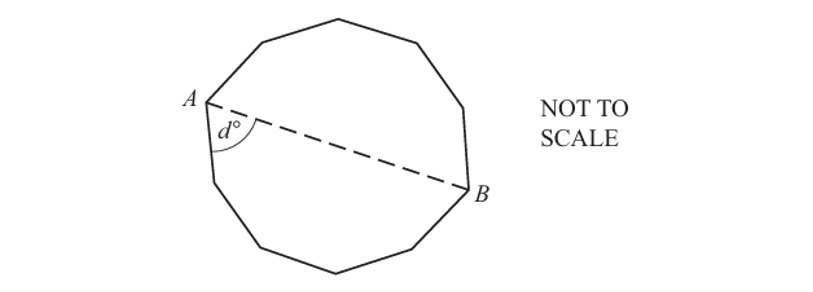
The diagram shows a regular decagon.
\(AB\) is a line of symmetry of the decagon.
\(AB\) is a line of symmetry of the decagon.
(a)
Work out the value of \(d\).
[2]
\[
\text{Interior angle of a regular decagon}
=
\frac{(10-2)\times180^\circ}{10}
\]
\[
=\frac{8\times180^\circ}{10}
\]
\[
=144^\circ
\]
\[
AB \text{ bisects the interior angle}
\]
\[
d=\frac{144^\circ}{2}
\]
\[
d=72^\circ
\]
\text{Interior angle of a regular decagon}
=
\frac{(10-2)\times180^\circ}{10}
\]
\[
=\frac{8\times180^\circ}{10}
\]
\[
=144^\circ
\]
\[
AB \text{ bisects the interior angle}
\]
\[
d=\frac{144^\circ}{2}
\]
\[
d=72^\circ
\]
(b)
The exterior angle of a regular polygon with \(n\) sides is \(45^\circ\).
Work out the value of \(n\).
Work out the value of \(n\).
[1]
\[
\frac{360^\circ}{n}=45^\circ
\]
\[
n=\frac{360}{45}
\]
\[
n=8
\]
\frac{360^\circ}{n}=45^\circ
\]
\[
n=\frac{360}{45}
\]
\[
n=8
\]
Question 10
\[
f(x)=5^x
\qquad
g(x)=3x-2
\qquad
h(x)=x^2+1
\]
f(x)=5^x
\qquad
g(x)=3x-2
\qquad
h(x)=x^2+1
\]
(a)
Find \(f(5)\).
[1]
\[
f(5)=5^5
\]
\[
=3125
\]
f(5)=5^5
\]
\[
=3125
\]
(b)
Find \(g(8x)\).
[1]
\[
g(x)=3x-2
\]
\[
g(8x)=3(8x)-2
\]
\[
=24x-2
\]
g(x)=3x-2
\]
\[
g(8x)=3(8x)-2
\]
\[
=24x-2
\]
(c)
Find \(g^{-1}(x)\).
[1]
\[
y=3x-2
\]
\[
y+2=3x
\]
\[
x=\frac{y+2}{3}
\]
\[
g^{-1}(x)=\frac{x+2}{3}
\]
y=3x-2
\]
\[
y+2=3x
\]
\[
x=\frac{y+2}{3}
\]
\[
g^{-1}(x)=\frac{x+2}{3}
\]
(d)
Find the positive solution of \(gh(x)=364\).
[1]
\[
g(h(x))=364
\]
\[
3(x^2+1)-2=364
\]
\[
3x^2+3-2=364
\]
\[
3x^2+1=364
\]
\[
3x^2=363
\]
\[
x^2=121
\]
\[
x=11
\]
g(h(x))=364
\]
\[
3(x^2+1)-2=364
\]
\[
3x^2+3-2=364
\]
\[
3x^2+1=364
\]
\[
3x^2=363
\]
\[
x^2=121
\]
\[
x=11
\]
(e)
Find \(ff^{-1}(12)\).
[1]
\[
ff^{-1}(12)=12
\]
ff^{-1}(12)=12
\]
Question 11
The diagram shows two mathematically similar triangles.
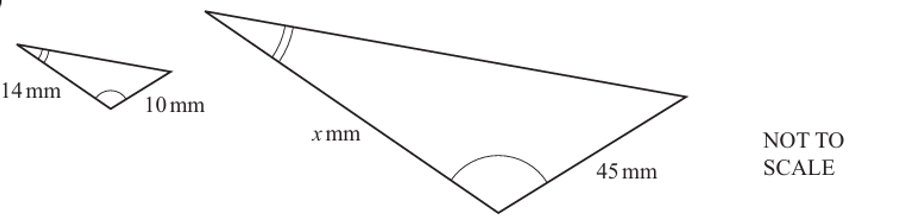
(a)
Find the value of \(x\).
[1]
\[
\frac{x}{14}=\frac{45}{10}
\]
\[
x=14\times\frac{45}{10}
\]
\[
x=63
\]
\[
x=63\text{ mm}
\]
\frac{x}{14}=\frac{45}{10}
\]
\[
x=14\times\frac{45}{10}
\]
\[
x=63
\]
\[
x=63\text{ mm}
\]
(b)
The surface areas of two mathematically similar containers are \(124\text{ cm}^2\) and \(279\text{ cm}^2\).
The capacity of the smaller container is \(56\text{ ml}\).
Find the capacity of the larger container.
The capacity of the smaller container is \(56\text{ ml}\).
Find the capacity of the larger container.
[1]
\[
\text{Area scale factor}=\frac{279}{124}=\frac{9}{4}
\]
\[
\text{Length scale factor}=\sqrt{\frac{9}{4}}=\frac{3}{2}
\]
\[
\text{Volume scale factor}=\left(\frac{3}{2}\right)^3=\frac{27}{8}
\]
\[
\text{Capacity of larger container}
=
56\times\frac{27}{8}
\]
\[
=189
\]
\[
189\text{ ml}
\]
\text{Area scale factor}=\frac{279}{124}=\frac{9}{4}
\]
\[
\text{Length scale factor}=\sqrt{\frac{9}{4}}=\frac{3}{2}
\]
\[
\text{Volume scale factor}=\left(\frac{3}{2}\right)^3=\frac{27}{8}
\]
\[
\text{Capacity of larger container}
=
56\times\frac{27}{8}
\]
\[
=189
\]
\[
189\text{ ml}
\]
Question 12
In the diagram, \(O\) is the origin and \(P\) lies on \(AB\) such that
\[
AP:PB=3:4
\]
\[
\overrightarrow{OA}=a
\qquad
\overrightarrow{OB}=b
\]
\[
AP:PB=3:4
\]
\[
\overrightarrow{OA}=a
\qquad
\overrightarrow{OB}=b
\]
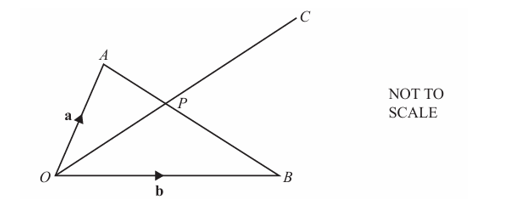
(a)
Find \(\overrightarrow{OP}\), in terms of \(a\) and \(b\), in its simplest form.
[2]
\[
\overrightarrow{AB}=b-a
\]
\[
\overrightarrow{AP}=\frac{3}{7}(b-a)
\]
\[
\overrightarrow{OP}
=
\overrightarrow{OA}+\overrightarrow{AP}
\]
\[
=a+\frac{3}{7}(b-a)
\]
\[
=a+\frac{3}{7}b-\frac{3}{7}a
\]
\[
=\frac{4}{7}a+\frac{3}{7}b
\]
\overrightarrow{AB}=b-a
\]
\[
\overrightarrow{AP}=\frac{3}{7}(b-a)
\]
\[
\overrightarrow{OP}
=
\overrightarrow{OA}+\overrightarrow{AP}
\]
\[
=a+\frac{3}{7}(b-a)
\]
\[
=a+\frac{3}{7}b-\frac{3}{7}a
\]
\[
=\frac{4}{7}a+\frac{3}{7}b
\]
(b)
The line \(OP\) is extended to \(C\) such that
\[
\overrightarrow{OC}=m\overrightarrow{OP}
\]
and
\[
\overrightarrow{BC}=ka
\]
Find the value of \(m\) and the value of \(k\).
\[
\overrightarrow{OC}=m\overrightarrow{OP}
\]
and
\[
\overrightarrow{BC}=ka
\]
Find the value of \(m\) and the value of \(k\).
\[
\overrightarrow{OC}
=
m\left(
\frac{4}{7}a+\frac{3}{7}b
\right)
\]
\[
\overrightarrow{BC}
=
\overrightarrow{OC}-\overrightarrow{OB}
\]
\[
=
m\left(
\frac{4}{7}a+\frac{3}{7}b
\right)-b
\]
\[
=
\frac{4m}{7}a+\left(\frac{3m}{7}-1\right)b
\]
Since \(\overrightarrow{BC}=ka\), the coefficient of \(b\) must be zero.
\[
\frac{3m}{7}-1=0
\]
\[
\frac{3m}{7}=1
\]
\[
m=\frac{7}{3}
\]
Now,
\[
k=\frac{4m}{7}
\]
\[
k=\frac{4}{7}\times\frac{7}{3}
\]
\[
k=\frac{4}{3}
\]
\overrightarrow{OC}
=
m\left(
\frac{4}{7}a+\frac{3}{7}b
\right)
\]
\[
\overrightarrow{BC}
=
\overrightarrow{OC}-\overrightarrow{OB}
\]
\[
=
m\left(
\frac{4}{7}a+\frac{3}{7}b
\right)-b
\]
\[
=
\frac{4m}{7}a+\left(\frac{3m}{7}-1\right)b
\]
Since \(\overrightarrow{BC}=ka\), the coefficient of \(b\) must be zero.
\[
\frac{3m}{7}-1=0
\]
\[
\frac{3m}{7}=1
\]
\[
m=\frac{7}{3}
\]
Now,
\[
k=\frac{4m}{7}
\]
\[
k=\frac{4}{7}\times\frac{7}{3}
\]
\[
k=\frac{4}{3}
\]
Question 13
The diagram shows a solid made up of a cylinder and two hemispheres.
The radius of the cylinder and the hemispheres is \(13\text{ cm}\).
The length of the cylinder is \(25\text{ cm}\).
The radius of the cylinder and the hemispheres is \(13\text{ cm}\).
The length of the cylinder is \(25\text{ cm}\).
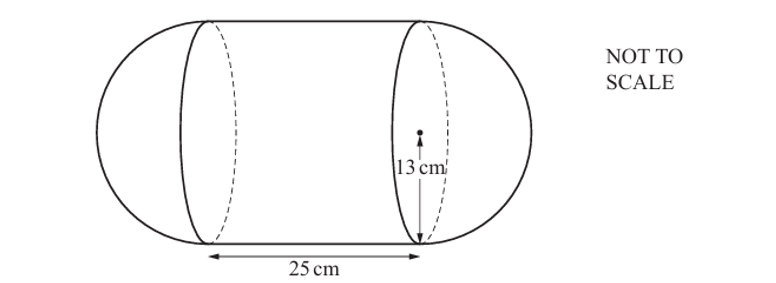
(a)
One cubic centimetre of the solid has a mass of \(2.3\text{ g}\).
Calculate the mass of the solid.
Give your answer in kilograms.
\[
\text{The volume, }V,\text{ of a sphere with radius }r\text{ is }V=\frac{4}{3}\pi r^3.
\]
Calculate the mass of the solid.
Give your answer in kilograms.
\[
\text{The volume, }V,\text{ of a sphere with radius }r\text{ is }V=\frac{4}{3}\pi r^3.
\]
[3]
\[
\text{Volume of solid}
=
\text{volume of cylinder}
+
\text{volume of sphere}
\]
\[
=\pi r^2h+\frac{4}{3}\pi r^3
\]
\[
=\pi(13)^2(25)+\frac{4}{3}\pi(13)^3
\]
\[
=4225\pi+\frac{8788}{3}\pi
\]
\[
\approx22478.2\text{ cm}^3
\]
\[
\text{Mass}=22478.2\times2.3
\]
\[
=51699.9\text{ g}
\]
\[
=51.7\text{ kg}
\]
\text{Volume of solid}
=
\text{volume of cylinder}
+
\text{volume of sphere}
\]
\[
=\pi r^2h+\frac{4}{3}\pi r^3
\]
\[
=\pi(13)^2(25)+\frac{4}{3}\pi(13)^3
\]
\[
=4225\pi+\frac{8788}{3}\pi
\]
\[
\approx22478.2\text{ cm}^3
\]
\[
\text{Mass}=22478.2\times2.3
\]
\[
=51699.9\text{ g}
\]
\[
=51.7\text{ kg}
\]
(b)
The surface of the solid is painted at a cost of \(\$4.70\) per square metre.
Calculate the cost of painting the solid.
\[
\text{The surface area, }A,\text{ of a sphere with radius }r\text{ is }A=4\pi r^2.
\]
Calculate the cost of painting the solid.
\[
\text{The surface area, }A,\text{ of a sphere with radius }r\text{ is }A=4\pi r^2.
\]
[4]
\[
\text{Surface area of solid}
=
\text{curved surface area of cylinder}
+
\text{surface area of sphere}
\]
\[
=2\pi rh+4\pi r^2
\]
\[
=2\pi(13)(25)+4\pi(13)^2
\]
\[
=650\pi+676\pi
\]
\[
=1326\pi
\]
\[
\approx4165.0\text{ cm}^2
\]
\[
4165.0\text{ cm}^2=0.4165\text{ m}^2
\]
\[
\text{Cost}=0.4165\times4.70
\]
\[
\approx1.96
\]
\[
\text{Cost}=\$1.96
\]
\text{Surface area of solid}
=
\text{curved surface area of cylinder}
+
\text{surface area of sphere}
\]
\[
=2\pi rh+4\pi r^2
\]
\[
=2\pi(13)(25)+4\pi(13)^2
\]
\[
=650\pi+676\pi
\]
\[
=1326\pi
\]
\[
\approx4165.0\text{ cm}^2
\]
\[
4165.0\text{ cm}^2=0.4165\text{ m}^2
\]
\[
\text{Cost}=0.4165\times4.70
\]
\[
\approx1.96
\]
\[
\text{Cost}=\$1.96
\]